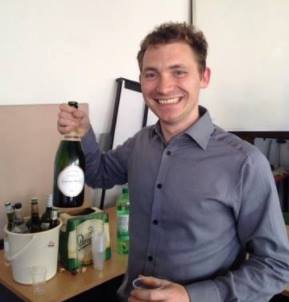
Last week I was back at Imperial college High Energy Physics department, where I spent 3.5 years working on my PhD. But this time, I was back as an external examiner for a PhD viva. It was a very validating experience to know that 8 years after my own PhD defence, I am now enough of an expert to be trusted with awarding doctorates.
I couldn’t help but mull over my own PhD viva experience (I even dug out a photo from that moment, see above!) and think over how we award doctorates. Indeed, how exactly a PhD is awarded is probably a bit of a mystery to those outside of academia, so I thought I’d dedicate this post to explaining a bit, although I am only speaking from my experience in particle physics.
The defence is the culmination of the PhD (Doctorate of Philosophy… philosophy here meant in its etymological meaning of pursuing knowledge). First, of course, the work which constitutes the PhD needs to be done, which means the student needs to first get familiar with the field and their topic, then become proficient at it, and finally to master it and make a novel contribution. Depending on where in the world the PhD is being prepared, it can take 2.5-5 years for this part (in some countries this also includes some taught courses equivalent to a European master’s degree). Then, towards the end of the active work, the candidate needs to write their thesis. That’s a document which is usually 100-200 pages long (mine was 110, I’ve heard of 600-page monsters), which lays out the work the candidate has done, and makes the case that they have made a new and original contribution to the field. This is usually the most tedious phase of a PhD: clearly writing down information which has usually been gained through experience can be difficult. Finding a way to present topics in a logical order is painful. Making clear what work was done by you, and what was done by others, is not easy. Properly citing other work, and avoiding plagiarism (and self-plagiarism) can be arduous. For example, all particle physics theses contain a section describing the detector. There are hundreds of ATLAS thesis manuscripts, and only one ATLAS. There are only so many ways you can describe it… and yet somehow we need to avoid copying previous work! And finally, fixing all the typos and issues spotted by your supervisors is soul-destroying. Still eventually one finishes writing the document, much to relief of students, supervisors and well-wishers.
But that’s not the end. To actually obtain the PhD, it needs to be defended. That means that people who are not the student’s supervisor need to assess if the work described in the manuscript is of high enough quality, quantity and originality to constitute to a novel contribution to the field. They also need to ensure that the contents of the thesis are really the work of the candidate, and that they actually understood what they did (and didn’t just turn the handle on someone else’s work).
The way this happens differs depending on the country, with varying levels of terror for the PhD candidate. I’ve been a PhD examiner for candidates in three countries (Australia, Spain and the UK), and those three countries already have vastly different systems (and even then it can vary from university to university). For example, for the Australian PhD I examined, everything happened remotely and over email (no free trip to the antipodes). The examiners read the manuscript, formulate a list of questions and recommendations, and then get an updated version to sign off on. The defence happens by correspondence. In Spain, the candidate gives a 20-30min presentation explaining their work, in person in front of a small committee (~3 people) and an audience of colleagues, friends and family. The committee, who have by then already read the manuscript, ask questions for half an hour or so, then agree on the outcome and any requested corrections. Then everyone goes to lunch to celebrate. The French system is more or less the same except that the committee is usually larger (>5 people), and hence the questions take longer. I’m told that Dutch PhD defences are similar, except that everyone is wearing academic robes and after exactly one hour, a special person in a special outfit comes in with a special stick, says some words in latin, and that ends proceedings. Then everyone goes for a drink to celebrate.
But in my view, the UK has one of the most intense and affective PhD defence examination methods. It’s typically called a “viva” (short for “viva voce” or live voice, meaning an oral examination). The committee is formed of just two people, one from inside the university, and one expert int the field from outside the university. They sit down in a room with the candidate and close the door. And then they ask questions on the manuscript and related topics, until they’re are done. They can be general questions about the field, specific questions about the results produced by the candidate, or questions which come up in the flow of discussion. It takes as long as it takes, often going page by page of the manuscript. It takes usually 4-6 hours. Mine took 4.5 hours, I know people whose viva lasted 7 hours. Unlike many countries, it is not a public event. Once the questions finish, the examiners confer privately for a few minutes, and announce the result the the candidate, after which everyone goes to have a nice cold beer, which is well deserved.
The UK system is a bit scary, but in my view it’s the best way for the examiners to determine if the candidate really understood their work and the context of it, and if their work was their own. It also allows examiner to gauge the depth of the candidate’s knowledge. The other systems, being public and often in front of friends and family are not conductive to this type of questioning, because no one wishes to make the candidate look bad or embarrassed in front of their mum and dad. Indeed, in a viva there is always a point where candidates don’t know the answer and say something silly. That’s because a typical examination technique is to ask more and more detailed questions on a given topic until the candidate doesn’t know anymore, as a way to determine how deep their understanding goes. On the flip side, the sense of achievement after the viva is unparalleled (see photo above!). Maybe I am a bit biased and passing down my trauma (having gone through this type of defence myself 8 years ago), but for me this is really the best way to conduct a PhD examination.
So there you have it, that’s how PhDs are born, at least according to my (limited) experience. As I said, each country has its own system… and soon, my own PhD student will be preparing for his defence here in France. It’s a new format for me, so it’ll be learning curve for him as well as for me !
 Louie D. Corpe
One thought on “PhD defences at home and abroad”