In my last post, I described some wonderful summary plots which were presented publicly for the first time at CERN a couple of weeks ago, at a workshop on CMS-ATLAS cooperation on their search programmes. But it was not the only result of mine that was premiered that week ! Hot on the heels of that first meeting, a second workshop on “re-interpretation” (re-use of experimental results this page) also took place at CERN the same week. Re-interpretation is a subject close to my heart. In a nutshell, the objective is to make the best use of all the searches and measurements made at the LHC so far, such that we can more easily get a handle on what new physics models are still allowed… and hence steer our dedicated searches to areas which are genuinely uncovered. At this year’s re-interpretation workshop, I was lucky enough to have not one but three new results presented by students of mine.
The first was a study of a new dark matter model, which had first been initiated during the CHACAL summer school I organised in South Africa last year. Clarisse Prat, a masters student at the Uni of Witwatersrand in Johannesburg, did all the heavy lifting. She produced exclusions on this new model using the CONTUR method (which uses the bank of precision measurements to derive exclusions), and compared it to a similar method called MadAnalysis (which uses the bank of search results to derive exclusions), and contrasted the results. Scientifically it was great to see the comparison between the two methods and determine how this new flavour of DM model was already excluded in some regions: I have no doubt future searches will take note so that we can focus on the unexplored areas. Personally, it was wonderful to see how the work we did to organise a summer school turned into a fruitful scientific collaboration involving students. Publication forthcoming, watch this space!
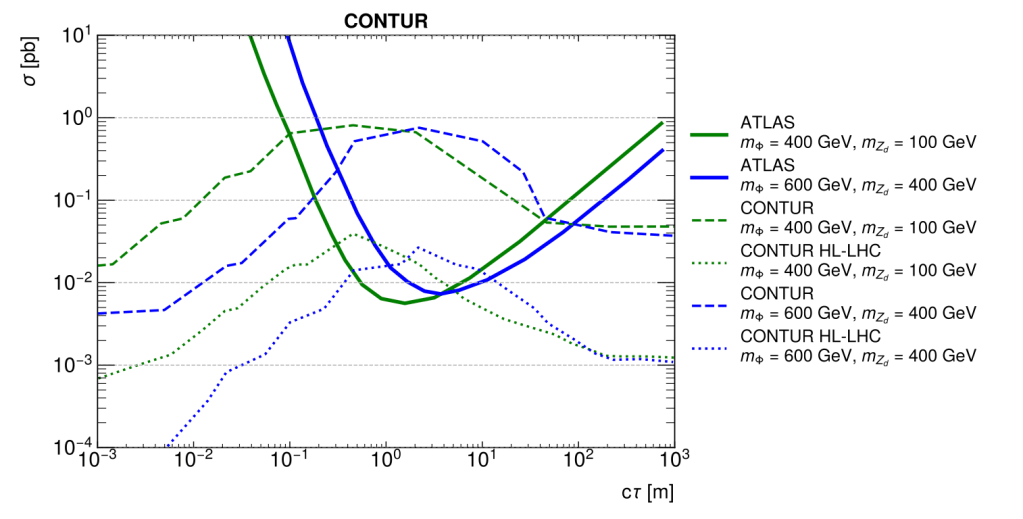
The second result was the outcome of a masters internship which I supervised last year. The student, Simon Jeannot, also used the CONTUR method, but managed to apply it to LLP models for the very first time (see our publication), deriving new constraints on relevant models, some of which we had only just started to explore in ATLAS (such as in this dedicated search of mine). It was one of those wonderful moments when an innovative new result comes unexpectedly. Indeed, the original idea of the internship for Simon was to apply CONTUR to a non-LLP new-physics models, a bit like Clarisse had done. But in over the course of the project, we figured out how we could apply it to a model with an unusual signature of a long lifetime (where CONTUR normally can’t reach), leading to a whole array of new results. That paper was published in JHEP with Simon as a co-author, and I was proud that his first trip to CERN was not as a tourist but as a researcher presenting his work to the wider community.
Finally, my PhD student Abdelhamid Haddad, presented a study based of a new re-interpretation method (which I discussed here and here), which we applied it a “asymmetric” long-lived particle model for the very first time, with the help of Andreas Goudelis, a theorist here at LPCA. This work also started off as masters project which we co-supervised (in fact, two masters projects, from Thomas Chehab and Louise Millot, in consecutive years). It really highlighted to power of the new reinterpretation method we developed. The result has been pre-printed on arXiv and will be submitted to a journal shortly, with the masters students as co-authors.
All in all, a busy time, and all this happening on top of my work as an ATLAS Exotics convener. But it really goes to show that masters students can make real contributions to scientific knowledge, and often bring their own ideas which help push projects into new and unexpected directions.
 Louie D. Corpe