An ATLAS paper I’ve been working on for about 2-3 years hit the arXiv today: https://arxiv.org/abs/2407.09168
Just in time for the big ICHEP conference (the biggest conference in particle physics) which takes place in Prague from Wednesday this week!
It is a follow-up to my previous search for pairs of exotic long-lived particles (see Searching for neutral long-lived particles with the full LHC run-2 dataset) which came out in early 2022. We use the same technology to identify potential exotic particles, but focus on cases where the new particle was produced alongside regular vector bosons (W or Z, the ones responsible for radioactive decays), or where one of the new particles decayed early enough to be reconstructed properly. Although having these extra objects in the event makes the process less likely to happen according to the theory, we can exploit them to reduce a lot of noise. This opens the door to probing new exotic particle models, such as photo-phobic axion-like particles (what a mouthful!) and dark photons.
Unfortunately we didn’t see any new particles, but we can use our results to draw a line in the sand for our theory colleagues constraining how often such new particles could be produced at the Large Hadron Collider.
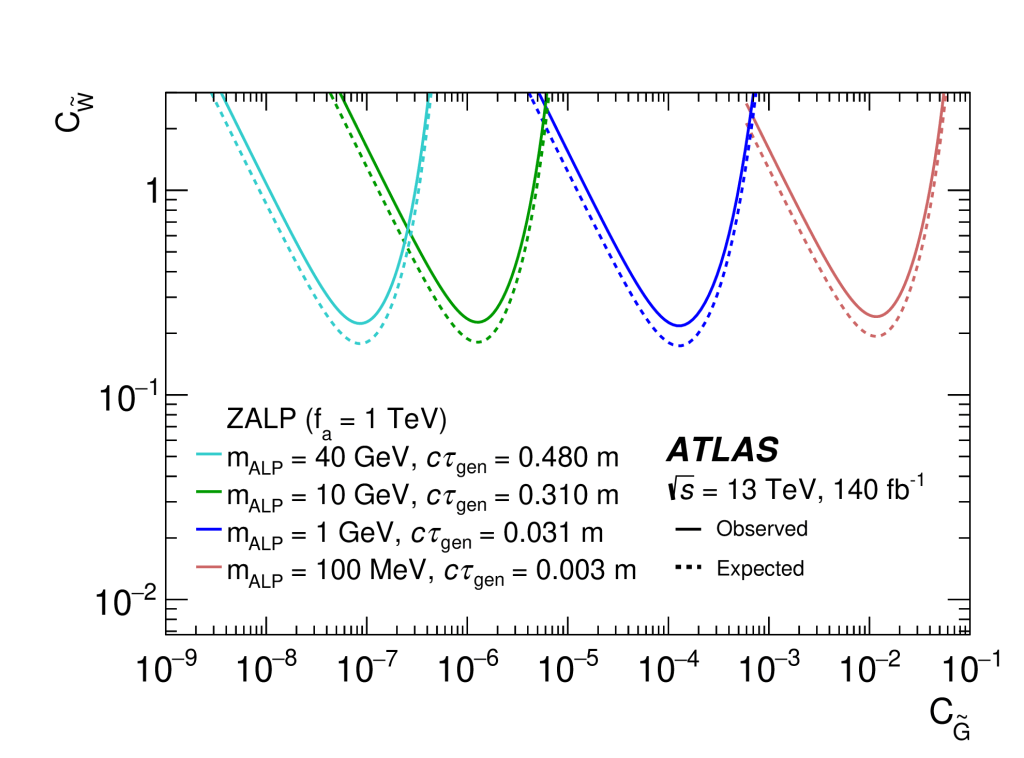
Something I’m really proud about with this paper is that it is published alongside novel re-interpretation material, which will make it easier for theorists to re-use our results in different contexts. The information we’ve given (as a boosted decision tree which maps simulation-level information to probabilities that an event would be selected after passing through the detector) is the result of years of back-and-forth, and improvements over the cours of three of three papers. In the plot below, you can see how the prediction (dotted line) can reproduce the full result (solid line) for a whole array of new particle mass hypotheses, including some which were not in the original paper. It means that if a theorist invents a new model in 30 years time, they can immediately estimate whether it would have been seen by our analysis.

This is also the first ATLAS paper for my PhD student, who helped develop the re-interpretation material.
 Louie D. Corpe
2 thoughts on “Long lived particles and their friends: a new step in the search programme”